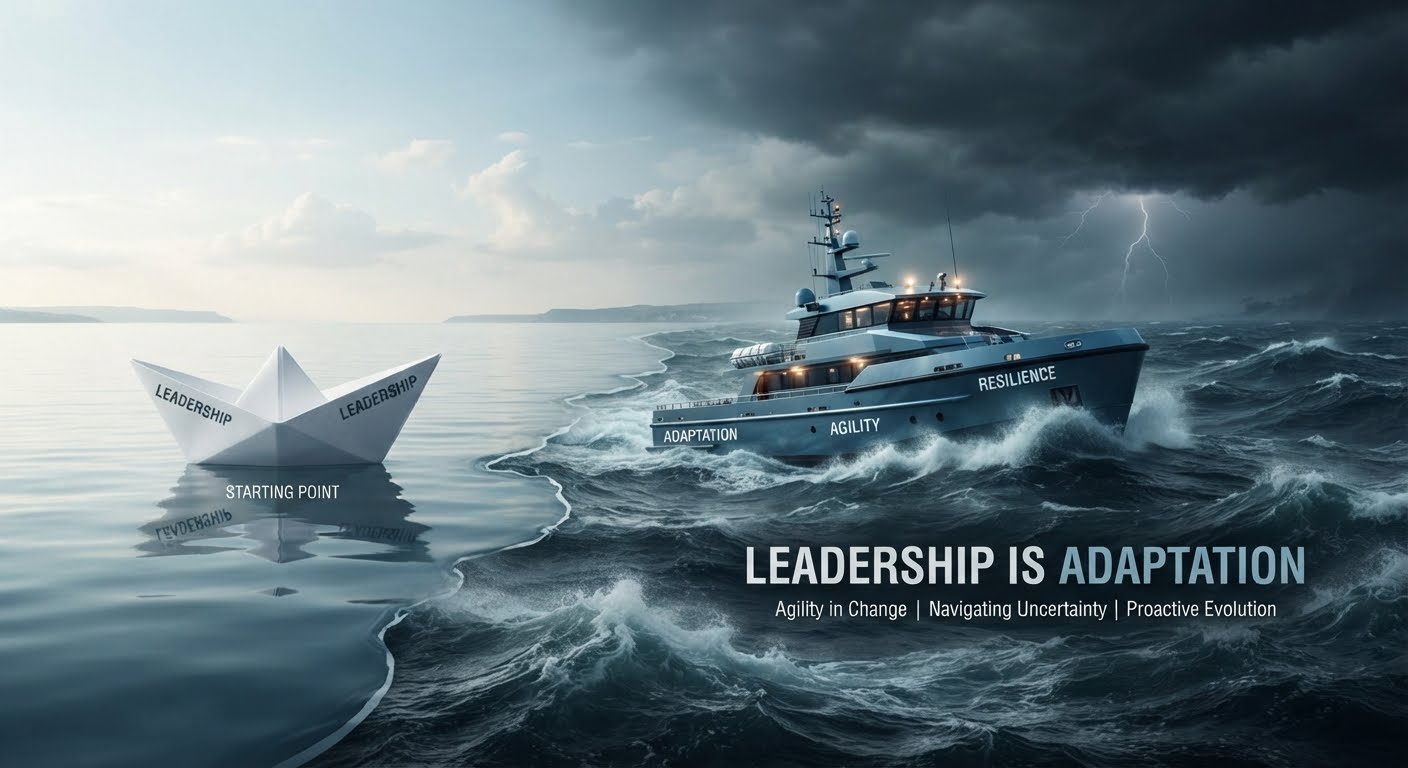
# Leadership Is Adaptation: Navigating Complexity in an Unpredictable World
The modern business landscape does not merely shift; it undergoes continuous, unpredictable mutations. Driven by exponential technological advancements, volatile global markets, and shifting cultural expectations, the traditional paradigms of command-and-control leadership have proven obsolete. Today, the foundational metric of a leader’s efficacy is no longer their ability to maintain compliance or enforce a static blueprint. Instead, leadership is fundamentally defined by the capacity for continuous, systemic adaptation.
To view leadership through the lens of adaptation is to recognize that organizations are not rigid machines, but living, dynamic ecosystems. Leaders who thrive in this environment do not impose rigid control; they cultivate a high level of responsiveness across their teams, enabling them to pivot seamlessly in the face of disruption. This extensive exploration details the core tenets of adaptive leadership, mapping out the frameworks, psychological foundations, and structural designs required to transform volatility into a competitive advantage.
—
## 1. The Fallacy of the Fixed Blueprint
For generations, corporate leadership relied on the illusion of predictability. The standard playbook dictated a straightforward sequence: analyze historical data, project a linear five-year trajectory, construct a rigid strategic plan, and enforce strict adherence to that plan. This approach operated under the assumption that the external environment would remain stable enough for the strategy to mature.
In a highly volatile, uncertain, complex, and ambiguous (VUCA) world, this reliance on fixed blueprints is a distinct liability. When a leadership team treats a strategic plan as an unalterable truth, they inadvertently build systemic blindness. They begin to ignore micro-signals of market shifts, dismiss disruptive innovations as passing trends, and penalize internal deviations that might actually serve as vital survival mechanisms.
“` TRADITIONAL PLAN: [Analysis] —> [Linear Strategy] —> [Strict Enforcement] —> (Vulnerable to Disruption) ADAPTIVE LOOP: [Signal] —> [Rapid Experiment] —> [Systemic Pivot] —> (Continuous Resilience). “`
Adaptive leadership requires a fundamental shift from a **predict-and-control** mindset to an **assess-and-respond** framework. This transformation does not mean abandoning long-term vision; rather, it means decoupling that vision from rigid execution tactics. The destination remains a guiding beacon, but the path taken to reach it must be treated as a series of working hypotheses, continuously tested and revised in real time.
—
## 2. Theoretical Foundations: Evolutionary Biology and Systems Thinking
To truly master adaptive leadership, one must look beyond traditional management theory and draw insights from evolutionary biology and complex systems thinking. Ronald Heifetz, a pioneer in the study of adaptive leadership at Harvard Kennedy School, explicitly distinguished between “technical challenges” and “adaptive challenges”:
* **Technical Challenges:** Problems that, while often complex, can be accurately diagnosed and resolved using existing expertise, established protocols, and historic organizational knowledge. Examples include deploying a standard software upgrade or optimizing a well-understood supply chain. * **Adaptive Challenges:** Problems that lack clear definitions, have no known solutions, and cannot be solved by experts alone. Resolving an adaptive challenge requires systemic changes in people’s values, beliefs, habits, and daily priorities. Examples include navigating a fundamental shift in consumer behavior, merging distinct corporate cultures, or integrating disruptive artificial intelligence across a legacy enterprise.
“` +———————+—————————–+————————————+ | Feature | Technical Challenges | Adaptive Challenges | +———————+—————————–+————————————+ | Problem Definition | Clear, identifiable | Obscure, systemic, multi-layered | | Solution Nature | Known protocols & expertise | Requires new learning & behavioral shifts| | Locus of Work | Assigned experts/authorities| The entire collective organization | | Primary Tool | Directives and management | Orchestrated tension & discovery | +———————+—————————–+————————————+ “`
Concurrently, systems thinking teaches us that organizations are complex adaptive systems (CAS). Like a biological ecosystem, an organization is composed of interconnected agents whose individual choices constantly alter the broader environment. A leader operating with a systems-thinking lens understands that they cannot control every outcome through sheer authority. Instead, they focus on adjusting organizational constraints, optimizing communication loops, and fostering the underlying conditions that allow positive, self-organizing behaviors to emerge.
—
## 3. The Psychology of Transition: Managing the Human Toll of Change
Adaptation sounds inherently positive in corporate brochures, but its practical application can be profoundly destabilizing for the individuals involved. Human beings are neurologically wired to seek predictability and minimize cognitive friction. When a leader signals a major strategic pivot, the team does not immediately see optimization; they frequently experience a profound sense of loss—loss of competence, familiarity, status, or established routine.
William Bridges’ famous transition model provides an invaluable framework for understanding this psychological progression, separating change (the external event) from transition (the internal psychological process):
1. **The Ending, Losing, and Letting Go Stage:** This is the immediate reaction to change, often marked by resistance, denial, and grief. Leaders must actively validate these emotions rather than dismissing them. Failing to acknowledge what people are leaving behind builds a toxic layer of resentment that can quietly paralyze any new initiative. 2. **The Neutral Zone:** The uncomfortable, chaotic limbo between the old reality and the unproven new way of working. While this phase can trigger high anxiety, it is also the most fertile ground for creativity and innovation. The lack of rigid structures allows new ideas to surface naturally. 3. **The New Beginning:** The final stage where individuals accept the change, develop a genuine alignment with the new direction, and begin building fresh competencies.
“` [ The Old Way ] —> ( 1. Ending & Loss ) —> ( 2. The Neutral Zone ) —> ( 3. New Beginning ) —> [ The Adapted Way ] | | | [Grief & Resistance] [Chaos & Innovation] [Alignment & Energy] “`
An adaptive leader acts as a psychological anchor throughout this journey. They establish a clear sense of psychological safety—a shared belief that the team will not be embarrassed, marginalized, or penalized for making honest mistakes, asking tough questions, or highlighting structural flaws. By maintaining this safety net, leaders lower the emotional costs of experimentation, encouraging individuals to step away from comfortable routines and embrace the discomfort of learning.
—
## 4. Architectural Agile: Designing Adaptable Structural Frameworks
An adaptive mindset is useless if it is trapped inside a rigid, bureaucratic organizational structure. Traditional corporate hierarchies, with their deeply siloed divisions and long, multi-layered approval chains, are fundamentally designed to minimize variance and preserve the status quo. To enable rapid adaptation, leaders must deliberately redesign their organizational architectures for speed, flexibility, and localized decision-making.
### Decentralized Decision-Making and Autonomy. The speed of market disruption requires that decision-making authority sits as close to the frontline as possible. Frontline employees are the first to observe changing customer preferences, operational friction, and competitor maneuvers. If every response requires a multi-layered escalation up to the executive suite, the organization will consistently miss its window of opportunity. Leaders must shift from making every decision to defining the core parameters within which local teams can act autonomously.
### Cross-Functional Pods Over Functional Silos: Instead of organizing teams by isolated functions (e.g., Marketing, Engineering, Sales), adaptive organizations build dynamic, cross-functional squads focused on specific customer outcomes or product lines. These pods possess all the skills necessary to design, test, and ship a solution independently, drastically reducing inter-departmental handoffs and communication delays.
### Shifting from rigid Budgets to Dynamic Capital Allocation: Traditional annual budgeting locks an organization into a fixed course of action for twelve months. An adaptive organization manages capital like a venture fund, utilizing rolling forecasts and allocating resources dynamically based on real-time performance signals and emerging market opportunities.
—
## 5. Strategic Calibration: The Art of the Controlled Pivot
Adaptation is not a license for reckless, chaotic movement. True adaptation is an intentional, highly disciplined process of strategic calibration. The goal is to balance the preservation of the organization’s core competitive advantages with a relentless willingness to transform everything else.
“` +——————————————————-+ | THE STRATEGIC BALANCING ACT | | | | [ Preserve the Core ] [ Transform the Rest ]| | – Purpose & Values – Delivery Tactics | | – Unique Value Prop – Operational Models | | – Long-term Vision – Technology Stacks | +——————————————————-+ “`
A masterful execution of this balance is seen in **Netflix’s** multi-decade evolution. Netflix did not view itself as a DVD shipping company; its foundational purpose was to deliver premium, on-demand entertainment. This clarity of core purpose allowed it to deliberately dismantle its highly profitable DVD business to fund the streaming revolution. Later, they adapted again by producing proprietary content, and they continue to adapt by integrating gaming and live events. Throughout these dramatic shifts, the core value proposition remained identical, while the operational delivery model was entirely rewritten.
To systematically execute these pivots without fracturing the company, leaders should implement a dual-operating model:
* **Engine 1 (The Core):** Optimizes, scales, and extracts value from the current, established business model. It requires high operational discipline, incremental innovation, and rigorous efficiency. * **Engine 2 (The Future):** Functions as an internal incubator, explicitly tasked with exploring speculative technologies, unproven business models, and untested markets. Engine 2 operates under a completely different set of KPIs, emphasizing rapid experimentation, speed to learning, and tolerance for intelligent failure.
—
## 6. The Adaptive Feedback Loop: From Signal to Scale
Systemic adaptation is driven by an ongoing feedback loop executed across all levels of the organization. This loop consists of four distinct phases: **Sensing, Hypothesizing, Testing, and Scaling.**
“` +—————–+ | 1. SENSING | <—+ +—————–+ | | | v | +—————–+ | |2. HYPOTHESIZING | | Continuous +—————–+ | Iteration | | Loop v | +—————–+ | | 3. TESTING | | +—————–+ | | | v | +—————–+ | | 4. SCALING | —-+ +—————–+ “`
### Phase 1: Sensing (Continuous Surveillance) Leaders must build an expansive network of internal and external sensors. This involves establishing direct, unvarnished communication lines with frontline staff, monitoring unstructured customer feedback, tracking macroeconomic shifts, and studying tangential industries for signs of disruption. The objective is to identify meaningful market anomalies before they escalate into industry-wide realities.
### Phase 2: Hypothesizing (Framing the Response) Once a disruptive signal is verified, the leadership team avoids jumping to an immediate, permanent solution. Instead, they reframe the challenge as a series of distinct business hypotheses. For example: *”If we introduce an automated, AI-driven service desk, we hypothesize it will reduce resolution times by 40% while preserving customer satisfaction.”*
### Phase 3: Testing (Low-Cost Experimentation) The framed hypotheses are then validated through rapid, low-fidelity experiments. Rather than funding a massive, multi-million-dollar rollout, the organization deploys a minimum viable product (MVP) to a small, isolated subset of users. This limits financial exposure while generating authentic, data-driven insights.
### Phase 4: Scaling (Institutionalizing the Change) If the data from the testing phase disproves the hypothesis, the experiment is shut down cleanly, the learnings are logged, and the team pivots. If the hypothesis is validated, the leader steps in to systematically deploy the solution across the broader enterprise, updating standard operating procedures and redirecting resources to support the new model.
—
## 7. Cultivating Resilience: The Adaptive Leader’s Mindset
Ultimately, an organization’s capacity for adaptation is a direct reflection of its leaders’ internal psychology. Structural changes, agile processes, and venture budgets are completely ineffective if the executive team remains trapped in a defensive, ego-driven mindset. Cultivating organizational resilience requires leaders to embody three distinct mental disciplines:
### Radically Transforming the Relationship with Failure In a traditional hierarchy, failure is viewed as a definitive sign of incompetence or poor execution. In an adaptive ecosystem, well-designed, informative failure is recognized as a primary mechanism of learning. Leaders must distinguish between **reprehensible failure** (caused by negligence, poor discipline, or ethical lapses) and **intelligent failure** (an unsuccessful outcome of a well-planned, carefully measured experiment). By publicly celebrating the insights gained from intelligent failures, leaders actively dismantle the paralysis of perfectionism.
### Developing High Cognitive Flexibility. Cognitive flexibility is the ability to simultaneously hold conflicting viewpoints, entertain divergent perspectives, and rapidly update beliefs when presented with new evidence. Cultivating this trait requires leaders to actively build cognitively diverse teams. Surrounding oneself with individuals who share the exact same background, industry training, and worldview creates a dangerous echo chamber. True adaptability relies on a friction of ideas, where long-held assumptions are routinely challenged.
### The Power of Intellectual Humility. The most critical asset for an adaptive leader is the willingness to say: *”I do not know, let’s find out together.”* Intellectual humility is the recognition that no single executive, regardless of their experience or tenure, can possess all the answers in a highly volatile market. When a leader surrenders the exhausting burden of omniscience, they open up space for collective intelligence, empowering the entire organization to think, innovate, and adapt.
—
## Conclusion: The Ultimate Competitive Advantage
The ultimate lesson of modern business history is clear: stability is an illusion. The organizations that endure across decades are not those that built the most impregnable fortresses, but those that learned to flow like water around unpredictable obstacles.
Leadership is not a static state of authority; it is an active, continuous process of adaptation. By moving away from fixed blueprints, embracing complex systems thinking, prioritizing psychological safety, and building flexible structures, leaders transform their organizations from fragile entities into resilient, highly adaptive ecosystems. In a world defined by relentless transformation, the capacity to learn, unlearn, and adapt is the only sustainable competitive advantage. Visit store.bleadersedge.com or bleadersedge.com for more leadership training…thanks!
Mike
#bleadersedge #TEAM123 #leadership #leadershiptraining #NotPower #Leadershipismore